

The Charity Governance Code has undergone its most significant revision in eight years, with an updated version published in November 2025. The revised Code introduces a new eighth principle, places greater emphasis on trustee behaviours and addresses emerging challenges like AI and environmental responsibility. Here’s what trustees need to know.
What is the Charity Governance Code?
The Charity Governance Code sets out the principles of good governance for charities registered in England and Wales. It’s distinct from the Charity Commission’s regulatory guidance; rather than setting out what charities must do, the Code is a practical tool to encourage trustees to discuss standards, behaviours and processes that cultivate good governance and best practice.
The Code operates on an ‘apply or explain’ basis, meaning charities are encouraged to adopt the principles and outcomes set out in the Code, or explain in their annual report what alternative approaches they take and why. Adopting the Code’s principles and outcomes provides strong and reassuring indicators to external stakeholders – including funders, regulators and beneficiaries – that a charity is well governed.
How has the Code been restructured?
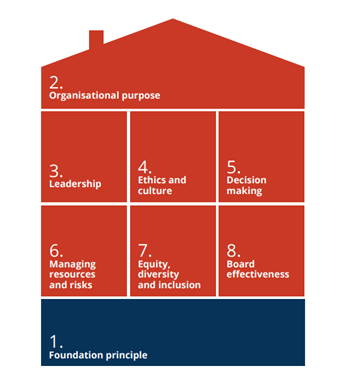
The 2025 Code is now structured around eight principles. The headline change is the introduction of a new Foundation principle, which makes explicit what was previously implicit: that trustees must understand their legal duties, commit to continuous learning and always put the charity’s interests first.
Good governance, the Code now emphasises, stands or falls on the strength of its foundations.
The remaining principles have been reorganised:
- Decision-making, risk and control has been split into Decision-making and Managing resources and risks
- Integrity and Openness and accountability have merged into Ethics and culture, with new emphasis on environmental sustainability
- The Diversity principle has been widened and renamed Equity, diversity and inclusion
- The principles of Organisational purpose, Leadership and Board effectiveness remain, with updated guidance.
What are the key changes?
Beyond the restructuring, several key shifts now drive the revised Code:
- Behaviours matter more than ever – the 2025 Code places considerably more emphasis on how boards behave, not just what structures they have in place. Each principle sets out the behaviours that support good governance, helping boards to discuss, debate, interpret and make decisions together
- Technology and AI – charities are now encouraged to have policies covering the use of technology and artificial intelligence, reflecting the fast-evolving landscape of cyber risk
- Environmental responsibility – the Code encourages charities to adopt sustainable practices and consider their environmental impact in investment decisions, operations and supply chains
- Enhanced stakeholder engagement – there is greater emphasis on engaging service users, volunteers and the wider community to inform decision-making
- One Code for all – unlike the earlier version, which offered separate recommendations for larger and smaller charities, the 2025 Code is scalable for organisations of all sizes.
Applying the principles
The Code provides a structured framework for each principle:
- Indicators of good governance
- Suggested behaviours
- Recommended policies
- Potential evidence.
These are intended not as a checklist, but as prompts for board discussion.
Practical steps for trustees
The launch of the revised Code provides an ideal opportunity for boards to strengthen or refresh their governance. The areas below may help guide your thinking:
- Conduct a governance review – assess your current governance arrangements against the eight principles. Where are you strong? Where are there gaps? A structured review can identify areas for improvement
- Hold a board workshop or away day – use the Code as a framework for open discussion about how your board is functioning – not just what structures are in place, but how trustees work together, make decisions and resolve disagreements
- Review your policies – the Code’s new areas of focus (technology and AI, environmental responsibility and equity, diversity and inclusion) may require new or updated policies. Consider whether your current policy suite reflects these expectations
- Refresh trustee induction – the Code, alongside the Charity Commission’s ‘The Essential Trustee’, should form part of your induction materials for new trustees
- Evaluate board effectiveness – the Code emphasises regular evaluation of the board’s performance. If you haven’t undertaken a formal effectiveness review recently, now may be the time
- Consider your governing document – does your constitution support modern governance practice? Older constitutions may benefit from updating to reflect current expectations.
Charities adopting the Code are encouraged to publish a brief statement in their annual report. A new Code website is expected later in 2026 with tailored resources.
How we can help
If any of the steps above prompt you to take action, our Charities and Not-for-Profit team can help. We regularly support clients with:
- Governance reviews – assessing your arrangements against the Code’s eight principles
- Board workshops and away days – facilitating open discussion about how your board is functioning
- Board effectiveness evaluations – conducting formal reviews of your board’s performance
- Policy reviews and updates – ensuring your policies reflect the Code’s new areas of focus
- Trustee training – helping new and existing trustees understand the Code and their responsibilities
- Constitutional reviews – updating your governing document to reflect modern governance practice.
How can we help you?
Related articles

Article
26 February 2026
5 minute read
Revitalising Trusts Programme helps charities access dormant funds
Read more
Article
26 February 2026
8 minute read
Making sense of the Charity Commission’s serious incident reporting updates
Read more


Article
22 October 2025
10 minute read
Essential duties of charity trustees: a refresher for effective governance
Read more
Article
12 August 2025
8 minute read
Sentebale scandal: lessons learned from Prince Harry’s charity row
Read more

Article
7 August 2025
7 minute read
Charity sector on alert for new failure to prevent fraud offence
Read more
Article
4 August 2025
6 minute read
Decision making for charity trustees: what we can learn from The Captain Tom Foundation inquiry
Read more
Article
29 July 2025
9 minute read
Civil Society Covenant launched to improve relationship between charity sector and government
Read more