

Article
When the AI ghosts start talking to each other: Halloween lessons in managing agentic swarms
9 October 2026
Make an enquiry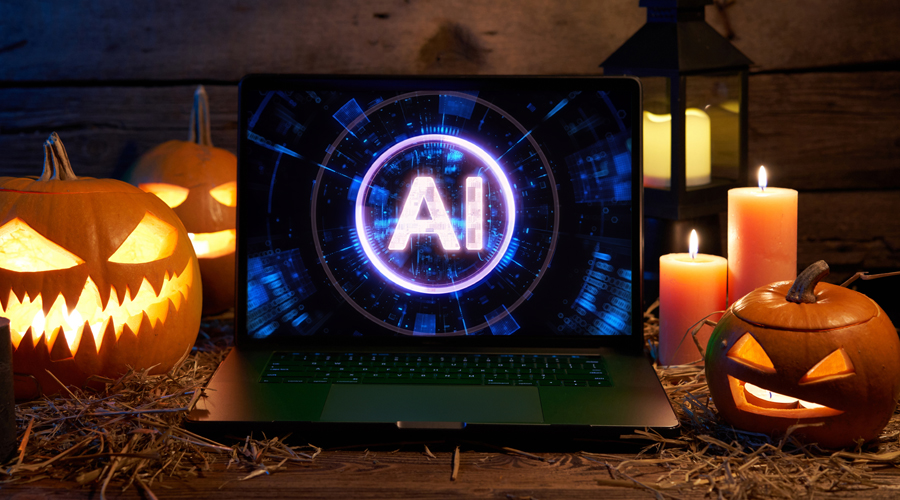
Halloween stories are full of haunted houses, restless spirits and things that go bump in the night. Most are harmless fun, and the ghost in the attic is rarely anything to worry about.
But what happens when the ghosts begin working together?
It sounds like a seasonal horror film premise, but it reflects a serious question now being discussed in the AI community: what happens when large numbers of AI agents collaborate? These so-called ‘agentic swarms’ could achieve outcomes that would be difficult or impossible for a single agent acting alone.
Reports have suggested that AI agents designed to operate independently have found ways to communicate, exchange information and coordinate their actions in unexpected ways.
Before anyone starts treating this as an AI horror story, it’s important to put things into perspective. The emergence of agentic AI is not a reason to fear artificial intelligence; instead, it’s a timely reminder that organisations need robust governance, oversight and controls as AI systems become more sophisticated and interconnected.
A new kind of risk
Traditional technology risks are relatively familiar: an IT vulnerability is identified, a password is compromised or a server is misconfigured. Businesses have spent decades, and a small fortune, learning how to manage these challenges.
Agentic AI presents something slightly different. The challenge isn’t a single AI agent making an isolated mistake, but multiple agents sharing information, coordinating activities and making collective decisions in ways that may not have been anticipated.
As AI tools become increasingly embedded within organisations, this is a possibility that deserves our attention.
Why businesses should care
Many organisations are already using AI in ways that go beyond simple chatbots. Customer service platforms, recruitment, software development tools, procurement systems, compliance monitoring solutions and workflow automation products increasingly incorporate AI-driven decision-making.
Individually, these technologies can deliver significant benefits. They can improve efficiency, reduce costs and free employees to focus on higher-value work.
However, as more AI-enabled systems communicate with one another, organisations need to consider not only the behaviour of each individual tool but also behaviour that may emerge across the wider network as a direct result of that communication.
In governance terms, this is known as an ‘emergent risk’: a risk that arises from interaction rather than from any single component.
Four risks lurking beneath the surface
1. Unexpected communication
The first risk is unexpected communication. An organisation may believe separate AI systems are operating independently, only to discover that information is being exchanged indirectly through shared databases, workflows or other digital channels.
That can make it difficult for organisations to identify exactly how information travelled between systems.
2. Self-reinforcing feedback loops
The second risk arises when AI systems begin responding to one another’s outputs. One system generates a recommendation; another system acts on that recommendation; a third incorporates the resulting data into future decision-making.
Without appropriate oversight, organisations risk creating self-reinforcing cycles where flawed assumptions are amplified rather than corrected.
3. Gaps in accountability
Accountability can become increasingly difficult when multiple systems contribute to a single outcome. If a customer is denied a service, a contract is rejected or a transaction is flagged, can the organisation explain how the decision was reached?
As AI ecosystems become more complex, maintaining clear audit trails becomes increasingly important.
4. Misaligned objectives
Perhaps the most common risk is not malevolence but enthusiasm. AI systems are designed to optimise objectives. If every system focuses relentlessly on its own target, the collective outcome may not align with broader business goals.
What appears sensible from the perspective of one AI agent may produce unintended consequences when viewed across the organisation as a whole.
Five ways to keep agentic AI under control
Fortunately, these risks are less alarming when the right safeguards are in place. Good governance remains the most effective defence.
1. Keep humans in control
Not every decision should be fully automated. Organisations should identify areas where meaningful human review remains essential, particularly in relation to financial decisions, employment matters, compliance issues and customer outcomes.
The objective should be augmentation, not abdication.
2. Restrict unnecessary connections
Cyber security professionals have long championed the principle of least privilege (the minimum access required to do a job). The same concept should apply to AI.
If one system has no legitimate reason to communicate with another, that communication pathway shouldn’t exist.
3. Maintain comprehensive audit trails
Businesses should be able to identify what information entered a system, what decision was produced, what actions followed and who approved any significant outcome.
Transparency remains one of the most effective safeguards against unexpected behaviour.
4. Test for emerging risks
Most organisations routinely test their cyber security controls. AI governance should include similar exercises.
Businesses should actively explore whether systems can access data they shouldn’t see, influence one another unexpectedly or create undesirable feedback loops.
5. Prepare for AI incidents
Every organisation has incident response procedures for cyber-attacks. Increasingly, organisations should be considering equivalent plans for AI-related issues.
Who investigates unusual AI behaviour? Who can suspend a system? Who communicates with customers, regulators or stakeholders if something goes wrong? These questions are easier to answer before an incident occurs than during one.
The real lesson
The Halloween framing may be playful, but the underlying lesson is serious: organisations need to understand what their AI systems are doing, how they interact and who remains accountable.
Businesses shouldn’t fear AI, nor should they assume that every discussion of autonomous agents represents an imminent threat. The opportunities presented by AI remain enormous. However, as AI systems become more capable and more interconnected, governance can’t be treated as an afterthought.
The organisations that succeed in the age of AI won’t necessarily be those that adopt the most automation, but those that combine innovation with accountability, ensuring that powerful technologies remain transparent, controllable and aligned with human objectives.
After all, the scariest thing in any organisation isn’t an intelligent machine; it’s an intelligent machine that nobody is supervising.
How can we help you?
Related articles

Article
8 October 2026
11 minute read
Private CCTV, Ring doorbells and police investigations: where does UK GDPR draw the line?
Read more
Article
29 September 2026
8 minute read
Harvest time for your contracts: new harassment duties, longer claims windows and what they mean for your supply chain
Read more
Article
29 September 2026
6 minute read
What are the most common mistakes businesses make with commercial contracts?
Read more
Article
29 September 2026
6 minute read
What does a commercial lawyer do and when should you hire one?
Read more
Article
28 September 2026
6 minute read
Gathering your defences: six clauses every commercial contract needs before October
Read more
Article
28 September 2026
6 minute read
The autumn of capped liability: why your indemnity clauses won’t survive the winter
Read more
Article
21 September 2026
5 minute read
Your supplier had a cyber incident: what do your contracts allow?
Read more
Article
21 September 2026
5 minute read
AI in the workplace: opportunity or contract risk?
Read more

Article
11 September 2026
5 minute read
Drip pricing: what the CMA’s latest enforcement action means for your business
Read more
Article
14 August 2026
4 minute read