
Resource
26 October 2026
3 minute read
This website will offer limited functionality in this browser. We only support the recent versions of major browsers like Chrome, Firefox, Safari, and Edge.
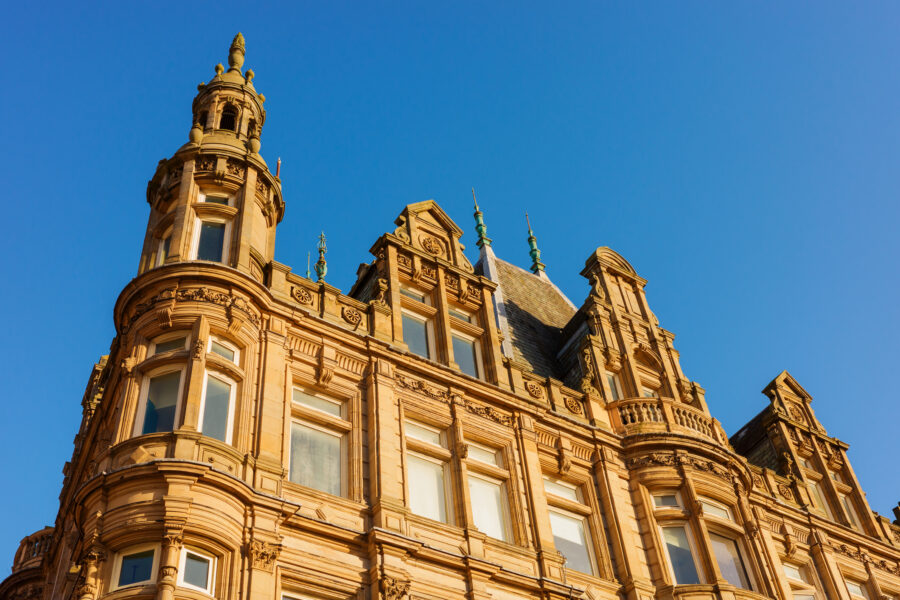
The fire at Glasgow Central Station is a reminder of just how vulnerable older and historic buildings can be and how much more difficult they are to insure, repair and restore than their modern counterparts.
For insurers and building owners, heritage properties bring a set of fire risks and claims challenges that are easy to overlook until something goes wrong. Maintaining these buildings to a safe and proper standard is an expensive and ongoing commitment. The specialist materials, traditional construction methods and skilled labour required mean that routine upkeep alone can cost many times more than equivalent work on a modern structure. When budgets are tight, essential maintenance is often deferred which allows fire risks to develop unchecked.
Old buildings were not designed with modern fire safety in mind, and many contain hidden dangers that can turn a small fire into a major incident.
One of the biggest problems is hidden gaps and cavities inside walls, floors and roofs. These spaces, left over from the way buildings were originally constructed, can act like chimneys, allowing fire and smoke to travel quickly and unseen through a structure. By the time firefighters arrive, the blaze may already have spread far beyond the point where it started. In a complex Victorian building like Glasgow Central Station, this risk is especially high.
Outdated electrical wiring is another common issue. Many older buildings still have wiring that has never been fully replaced. Over the years, the protective covering on old cables breaks down, connections work loose and the chance of an electrical fault grows. Even where new wiring has been installed, it may run through the same old cavities alongside timber and other materials that burn easily.
The building materials themselves add to the danger. Older structures tend to use a great deal of timber in their frames, floors and roofs. Decorative plasterwork, wooden panelling and ornate ceilings may look impressive, but they also provide plenty of fuel for a fire. Modern buildings, by contrast, are built with fire-resistant materials and are designed to stop flames spreading from one part of the building to another, protections that simply did not exist when heritage buildings were first constructed.
Repair and maintenance work is another frequent trigger. When contractors carry out work using blowtorches, welding equipment or other heat-producing tools (hot works) the combination of exposed timber, dust and debris in hidden spaces can easily ignite if proper precautions are not taken.
Insurance premiums for heritage buildings have risen sharply in recent years and the reasons are not hard to understand. Insurers rate the risk of older properties by reference to a range of factors including the age and construction type of the building, the materials used, the condition of electrical and heating systems, the presence or absence of modern fire detection and suppression measures and the claims history of the property. Heritage buildings tend to score poorly against almost all of these criteria. The result is that premiums can be several times higher than for a comparable modern building and excesses are often set at elevated levels to reflect the greater uncertainty around claims costs.
There appears to be growing concern within the insurance market that some heritage properties are becoming effectively uninsurable. Where a building has a history of significant claims, lacks adequate fire safety measures or has been poorly maintained, insurers may decline to offer cover at all or may impose conditions so restrictive as to make the policy impractical. The combination of high restoration costs, long reinstatement periods and the difficulty of applying modern safety standards to protected structures means that the risk profile of some heritage buildings now falls outside the appetite of mainstream insurers. In extreme cases, owners are forced to seek cover through specialist markets at very considerable expense or face the prospect of being uninsured.
When a heritage building suffers fire damage, sorting out claims and carrying out repairs will almost always be slower, more complicated and more expensive than it would be for a modern property. Because these buildings are often listed or protected, owners cannot simply rebuild however they choose. Repairs usually have to match the original construction as closely as possible, using traditional materials and methods. That can mean tracking down rare stone, specialist timber or handmade components and hiring skilled craftsmen who may be in short supply. Approval is also needed from heritage bodies (such as Historic Environment Scotland) which adds further time and cost.
A common problem is underinsurance. Standard rebuilding cost estimates often fall well short of what it actually costs to restore a heritage building. Disagreements can also arise over whether modern fire safety improvements can be added during the restoration without affecting the building’s protected status.
Funding is available to help owners address fire safety in heritage properties, though they are not always well known or easy to access. In Scotland, Historic Environment Scotland administers grant programmes that can contribute towards essential repairs and safety improvements to listed buildings and scheduled monuments. In England, Historic England offers similar support and the National Lottery Heritage Fund has historically provided funding for major restoration and conservation projects, which can include fire safety upgrades. Local authorities may also have discretionary grant schemes for buildings in conservation areas.
However, a persistent difficulty is ensuring that available funding is properly applied. Grant conditions do not always require recipients to prioritise fire safety over aesthetic or structural restoration and there is limited follow-up to verify that safety improvements have been carried out to an adequate standard. Where funding is awarded for broad conservation purposes, fire safety measures can be treated as secondary, particularly where they are seen as difficult to reconcile with the preservation of historic fabric. There is a strong argument for ring-fencing a proportion of heritage funding specifically for fire prevention and detection measures and for imposing clearer conditions on how such funds are spent.
The Health and Safety Executive (HSE) plays an important role in overseeing the safe management of heritage buildings, particularly those that are open to the public or used as workplaces. Under the Health and Safety at Work etc. Act 1974 and the Regulatory Reform (Fire Safety) Order 2005 (in England and Wales), or the Fire (Scotland) Act 2005 and associated regulations in Scotland, the responsible person for a building is required to carry out suitable and sufficient fire risk assessments and to take reasonable steps to reduce and manage the risk of fire.
The HSE has acknowledged that heritage buildings present particular challenges. The need to balance the preservation of historic fabric with the safety of workers and visitors means that a proportionate and risk-based approach is required. In practice, this involves working with building owners, conservation officers and fire safety professionals to identify solutions that protect life without causing unnecessary damage to the building’s character. The HSE expects that where large numbers of visitors attend heritage properties, as is the case with major railway stations, historic houses and public monuments, the fire risk assessment and associated safety measures must be especially robust. Means of escape, fire detection, staff training and emergency planning must all be tailored to the specific risks of the building, taking into account its layout, construction, occupancy levels and any restrictions on physical alterations.
Given the volume of visitors to heritage sites across the United Kingdom, the consequences of a serious fire can extend well beyond property damage. The potential for loss of life, serious injury and long-term psychological harm emphasises the importance of treating fire safety in these buildings as high priority. Despite these challenges, there are practical steps that building owners and insurers can take to improve fire safety in heritage properties. Thorough fire risk assessments, carried out by specialists who understand old buildings, are a good starting point. These should particularly focus on hidden voids, electrical systems and any areas where old and new building work meet.
Modern smoke detection technology can now be fitted in concealed spaces without causing damage to historic fabric, giving early warning before a fire takes hold. Strict rules around hot works during any building or maintenance project are essential, including fire watches and formal permit systems. Building owners should also make sure their insurance cover is regularly reviewed and reflects the true cost of heritage restoration, not just a standard rebuild figure. Where grant funding has been obtained for fire safety improvements, owners should ensure that the work is completed to a high standard and that records are maintained for insurers and regulatory bodies. Insurers, for their part, need to write policies that properly reflect the particular risks of heritage buildings.
When a claim arises, they should bring in loss adjusters and restoration specialists who are very experienced in dealing with listed building repairs. Insurers and brokers should also take the time to sit down with building owners, talk them through how their risks are assessed and explain in straightforward terms what they can do to make their property easier and more affordable to insure. The Glasgow Central Station fire is a reminder that old buildings need a different approach. With the right precautions, adequate funding properly directed towards fire safety and genuine collaboration between building owners, insurers, heritage bodies and regulators, the worst outcomes can be avoided but only if the risks are properly understood and planned for.