Article
21 September 2026
4 minute read
This website will offer limited functionality in this browser. We only support the recent versions of major browsers like Chrome, Firefox, Safari, and Edge.
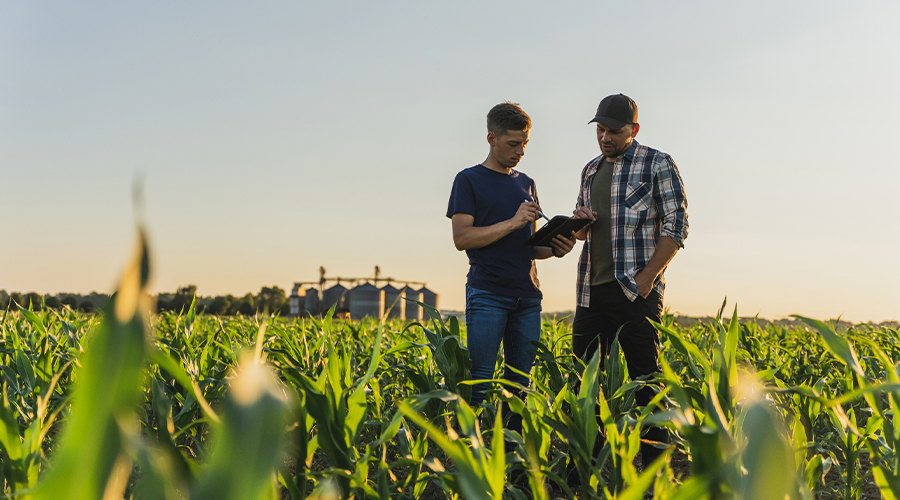
The farming industry has advanced significantly since the early to mid‑1990s, when basic GPS – something we all take for granted (and occasionally shout at) – was first introduced for civilian use.
This marked a major technological breakthrough for farming, enabling farmers to map field variations and manage input applications more effectively. However, widespread adoption was initially slow due to high investment costs and slow development.
Nowadays, precision agriculture is a central feature of a modern farm and it’s increasingly common to see machinery equipped with GPS, data optimisers and sensor technology.
To appreciate how far technology has come since the 1990s, farmers now use systems capable of recording crop light reflection, calculating fertilisation requirements and automatically adjusting the amount of fertiliser applied to the soil. What’s more, this is controlled by a compact computer mounted on top of the tractor’s cab.
The benefit of adopting such a data‑centric system is that landowners can use this information to predict yield through site‑specific management and real‑time sensing. This approach helps optimise agronomy and enables earlier detection of potential issues, allowing landowners to take proactive steps to minimise risk.
Precision farming can also support the anticipation of market supply and demand through audits, supply chain transparency and participation in carbon and biodiversity schemes.
Most importantly, as with any business, data can help reduce losses and expenditure – for example, by improving the efficiency of chemical and fertiliser application, while enhancing the monitoring of weather, disease and soil conditions.
Precision farming isn’t without its challenges. While technology has advanced significantly since the introduction of GPS, the cost of adopting new systems isn’t always practicable for small or medium‑sized farms.
In addition, although internet coverage is generally good across much of the UK, many rural areas continue to struggle with reliable connectivity.
Whenever data is involved, legal requirements are not far behind. With major concerns around data privacy and GDPR, farmers must also navigate laws that impose strict requirements on the collection, storage and sharing of farm data.
It’s clear the UK is a strong contender in both the agricultural and tech sectors. Farmers are supported by government-backed initiatives and there’s significant involvement in major innovation projects by investors.
However, compared with its European and global counterparts, the UK’s progress in precision farming sits somewhere in the middle. It continues to lag behind countries such as the Netherlands, Germany, the US and Australia, which benefit from larger‑scale operations and substantial investment in digital infrastructure.
While it’s clear that there are substantial upsides to precision farming, whether this will continue to benefit the UK will depend on continued investment in technology, education and rural connectivity. As the sector expands, it’s important that investors, tech providers and farmers work together to unlock the full potential of data-driven agriculture and ensure the benefits of precision farming remain accessible to all.