Article
21 September 2026
4 minute read
This website will offer limited functionality in this browser. We only support the recent versions of major browsers like Chrome, Firefox, Safari, and Edge.
1 September 2026
Make an enquiry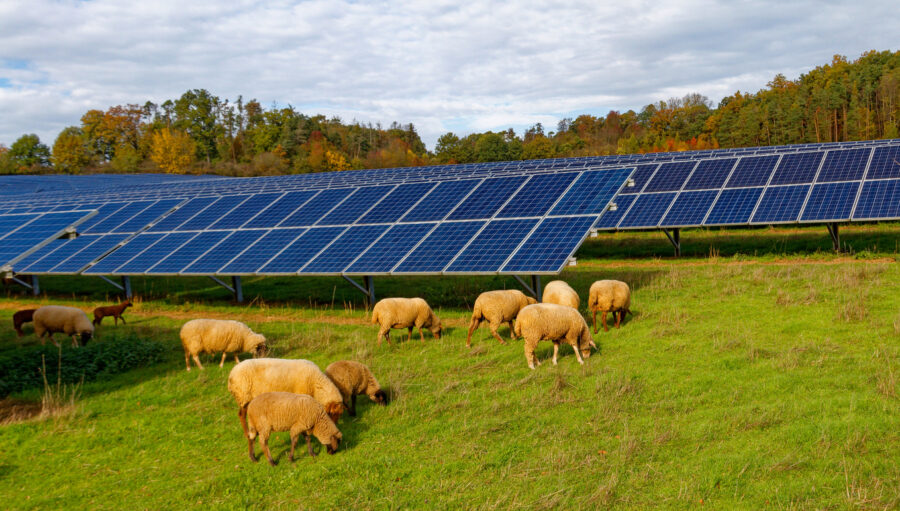
If you own farmland, there’s a good chance you’ve been approached — or will be approached — by a developer looking to use your land for a renewable energy project. Solar farms, wind turbines and battery storage facilities are all expanding rapidly across the UK, and developers need land.
The financial returns can be attractive, but the agreements involved are complex and long term. Before you sign anything, it’s important to understand what you’re committing to.
Most projects begin with an option agreement and you’ll often receive an upfront option fee for entering into the agreement. This gives the developer an exclusive right to develop the site, usually while they seek planning permission.
If planning is granted, the option is exercised and a lease is entered into. Some arrangements also involve easements (rights over your land for cables, access roads or substations). These are legally binding documents with significant consequences, and you should never treat them as formalities.
These agreements are not short-term. An option period might run for three to five years (sometimes longer), often with an opportunity to extend on payment of an additional option fee if there’s a delay in obtaining planning permission or grid connection agreement.
If the project goes ahead, the lease will typically last 25 to 40 years, often with options to extend. You are potentially tying up your land — and limiting what you can do with it — for decades. Think carefully about how that fits with your long-term plans for the farm, succession planning and any future development aspirations you may have for the site.
Rent is usually paid annually and can be structured in different ways: a fixed sum, a payment linked to an index (such as CPI), a percentage of the project’s turnover or a combination.
Each approach carries different risks. A fixed rent gives certainty but may not keep pace with inflation. Index-linked payments offer some protection. Turnover-based rent can be lucrative if the project performs well but may disappoint if energy prices fall.
Make sure you understand when payments start, how they are reviewed and what happens during the option period before any lease income begins.
During the option period, the developer will usually have exclusivity to assess the viability of the project and obtain necessary consents, meaning you can’t deal with competing developers without their consent.
Consider what happens if planning permission is refused or the developer simply fails to progress the application. You should ensure the option has a clear longstop date and that exclusivity doesn’t continue indefinitely without the project moving forward.
Once a project is operational, your ability to use the land will be significantly restricted. You may lose the right to farm parts of the site, erect buildings, plant trees or carry out activities that could interfere with the equipment.
Make sure you fully understand which areas are affected and what activities are and aren’t permitted. You should carefully consider what other projects may be ongoing on your land and how these interact with the proposed renewables development.
Most new developments in England now need to deliver a minimum 10% biodiversity net gain (BNG) under the Environment Act 2021. This can create opportunities for landowners — you may be able to provide BNG units on other parts of your holding, generating an additional income stream.
However, BNG obligations are secured by conservation covenants or planning conditions that last for at least 30 years. Crucially, if the main renewables lease ends early — for example, because the developer goes into administration or the project is decommissioned ahead of schedule — the BNG obligation on your land doesn’t necessarily fall away. You could be left managing a 30-year habitat commitment without the lease income you were relying on.
It’s important to understand exactly what BNG commitments are being made, who is responsible for maintaining them and what happens if the project doesn’t run its full course.
At the end of the lease, the developer should be required to remove all equipment and restore the land to its former condition. But what if the developer has gone out of business by then? Check whether there’s a bond, guarantee or other security to cover decommissioning costs, including any ongoing BNG obligations. Without adequate protection, you or your successors could be left with the bill.
Entering into a renewables agreement can have significant tax consequences. Agricultural Property Relief (APR) for inheritance tax purposes may be lost if the land is no longer used for agriculture. There may also be capital gains tax implications on the grant of a lease, and the rental income will be subject to income tax.
Take specialist tax advice early, ideally before heads of terms are agreed and certainly before entering into the option agreement.
If any part of the land is let to a tenant farmer, you’ll need to consider how the project interacts with that tenancy.
You should also check the impact on any environmental land management schemes, countryside stewardship agreements or successor schemes to the Basic Payment Scheme. Entering into a renewables agreement could disqualify you from certain payments or create clawback liabilities.
Developers will sometimes press for a quick signature, but there’s rarely a genuine reason for urgency. A first offer is almost always negotiable on rent, terms and protections. Take your time, ask questions and don’t feel pressured into signing something you don’t fully understand.
The single most important step you can take is to instruct a full professional team as early as possible: a solicitor, accountant and agent, ideally before heads of terms are agreed.
The developer’s solicitor acts for the developer, not for you. Your team will help you understand what you’re agreeing to, consider the legal, tax and practical implications, negotiate better terms and avoid costly mistakes that may not become apparent for years.