
Article
HCR Law brings in-house legal leaders together to discuss evolving challenges and opportunities
1 June 2026
Make an enquiry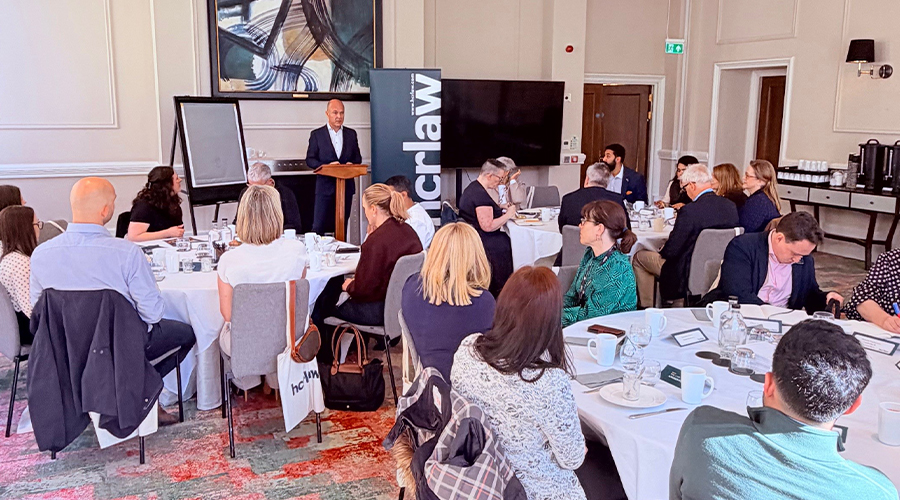
In-house legal teams are busier than ever, as the value of their knowledge and expertise is increasingly being called upon at Board level.
As businesses and organisations face growing regulatory scrutiny, governance changes and operational risk, the in-house legal team is being relied upon as a strategic partner.
For the past two years, we’ve built a supportive network where in-house counsel can openly share the issues they face in an informal and trusted environment. Our latest In House With You breakfast attracted more than 30 guests, who took part in a closed-door discussion moderated by HCR Law’s Head of Commercial, Robert Capper.
When legal works well, it can be invisible
A recurring theme of the roundtable was how easily the true value of an in-house legal function can be overlooked when everything is running smoothly. Much of Legal’s impact lies in anticipating, identifying and resolving issues before they escalate, meaning problems never reach the boardroom. This preventative role is essential, but conversely it can also make Legal’s contribution harder to evidence.
And if you can’t provide evidence of a service, the Board’s agreement to invest properly in that service could be more difficult to secure, just at the time when the organisation is growing and needs more legal expertise, not less.
As a result, in-house legal teams are increasingly using data and metrics to demonstrate productivity and the risks that have been avoided.
Some are also positioning the legal function as a distinct business unit in its own right, with commercial objectives and all are adopting technology, including the strategic use of AI.
Increasingly, teams are also bringing in flexible external legal support at peak periods to improve efficiency, rather than increasing full-time headcount.
How to tackle the rising and changing workload
This increase in workload is driven by a number of factors.
In-house teams are seeing a noticeable rise in AI-generated grievances, complaints and subject access requests. In several cases, teams are having to assess well-presented, AI-generated complaints which, when reviewed by a human, often turn out to have little or no substance.
However, unpicking these issues still consumes valuable time and capacity that could be better spent on more strategic work.
Understanding where technology can really help
Many teams are investing in new case management systems, but there was some scepticism around dashboard reporting that produces impressive-looking information rather than genuine insight.
It’s all very well creating attractive graphs and statistics, but what do they actually mean for the business?
What’s needed are dashboards that genuinely support decision making and operational efficiency, rather than reporting activity for its own sake. You can read more on this in our article on Dashboards here.
Boards can also be willing to approve and invest in new technology without fully understanding its true capabilities or appreciating the implementation burden placed on legal teams.
Buying the technology itself may be a justifiable capital investment, but the budget for allocating additional resource for governance, oversight and issue management doesn’t always follow.
AI adoption: Opportunity versus risk
Most in-house legal teams are now using AI in some form, but levels of maturity, governance and risk awareness vary widely. While Boards are encouraging greater AI adoption, many are not fully alive to the data protection, confidentiality and privilege risks involved.
A key concern raised was the potential loss of legal privilege when using public AI tools. Uploading confidential or privileged material into open platforms risks permanent waiver of privilege, alongside issues around data reuse and third‑party disclosure. Participants emphasised the importance of enterprise‑grade, closed AI systems that do not train on user data.
Cyber incidents continue to be a major board‑level concern, with uncertainty persisting around the ownership of oversight between Legal and IT teams. This highlighted the need for clear internal governance, defined responsibilities and strong cross‑functional alignment, particularly as regulatory scrutiny and litigation risks increase.
The future shape of in-house legal teams
Building and scaling in-house teams remains challenging, particularly in regulated or specialist areas such as governance, environmental law or health and safety.
Inconsistent salary benchmarking across sectors is also prolonging recruitment processes and making it harder to secure the right level of expertise at an acceptable cost.
Many participants described being at, or beyond, capacity, with limited scope to absorb additional work using existing resources.
Combining smarter use of data, technology and alternative flexible resourcing models is essential, but it all comes back to making it clear to the Board just how central the in-house legal function is to the business.
Legal teams play an active role in supporting business growth, not just managing risk when things go wrong.
Following the event, participant Pardeep Lagha, Legal Director at The NEC Group, said: “HCR Law consistently runs excellent in-house events and I always find it worthwhile taking the time out to attend these.”
Baljinder Singh Atwal, Senior Solicitor at West Midlands Police, added: “I really value the in-house community HCR Law is building. It’s a rare opportunity to connect with other in-house lawyers that I wouldn’t ordinarily meet elsewhere.”
We will be hosting further HCR Law, In House With You events later this year, continuing to support in-house lawyers with the opportunity to come together, share experiences and build this supportive community. If you are interested in attending please contact a member of the In-House With You team.
How can we help you?
Related articles

Article
22 June 2026
9 minute read
Leases: rethinking upwards-only rent reviews – the 2026 Act in practice
Read more
Article
17 June 2026
9 minute read
Matter management: why it’s a core risk discipline for in-house legal teams
Read more

Article
11 June 2026
8 minute read
Litigation risk management: when to settle, defend or escalate
Read more
Article
22 April 2026
11 minute read
Future‑ready legal teams: how rising expectations are reshaping in‑house legal
Read more
Article
21 April 2026
8 minute read
Beyond compliance: Practical strategies for navigating regulatory overload
Read more
Article
21 April 2026
7 minute read
Flexible resourcing: how general counsel are rethinking external counsel
Read more
Article
21 April 2026
8 minute read
Fraud and Financial Misconduct: How GCs are modernising control frameworks
Read more
Article
21 April 2026
16 minute read
Intellectual property update: key developments for in-house counsel
Read more
Article
21 April 2026
9 minute read
Navigating whistleblowing: practical guidance for in-house lawyers
Read more