Article
22 June 2026
9 minute read
This website will offer limited functionality in this browser. We only support the recent versions of major browsers like Chrome, Firefox, Safari, and Edge.
The in-house legal function is growing in both size and influence. But with AI accelerating, geopolitical risk increasing and the boundaries between legal, technology and business risk becoming increasingly blurred, what should General Counsel be building now to ensure their teams are ready for 2035?
2035 may sound comfortably distant. In reality, it is less than a decade away.
For General Counsel and senior in-house legal leaders, the question is not simply what the legal function might look like by then. It is whether the decisions being taken today are creating teams equipped for the considerably more complex environment they are likely to inherit.
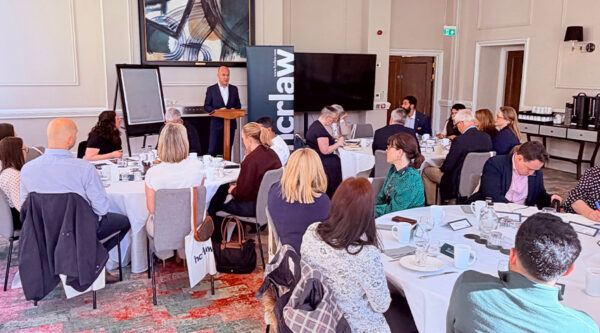
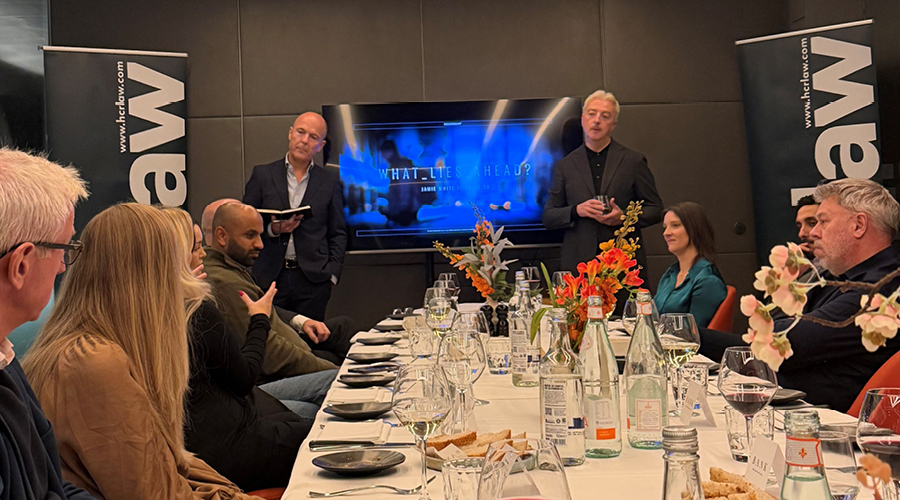
That was the focus of a recent private dinner hosted by HCR Law’s In-House With You team, bringing together General Counsel and Senior Legal Counsel for a discussion led by Jamie White, co-founder of strategic consultancy Prosperant.
The starting point was striking: the transformation of the in-house function is not something waiting for us in 2035. It is already happening.
The data shared by Prosperant points to a fundamental shift in where legal capability sits.
Employment data analysed by ACC alongside SRA population data showed in-house legal employment growing by 87%, compared with 23% growth in law firms. In-house has grown almost four times faster than private practice.
The picture in the largest firms runs the other way. Top 10 UK firm headcount fell 2%, reversing growth the year before. Trainee intake at those firms fell 11% in a single year, while chargeable hours for fixed share equity partners fell 8.6%. (PwC Survey of Private Practice Law Firms 2026). At the same time, 74% of UK in-house leaders plan to grow their disputes headcount over the next three years,
In-house teams are not simply becoming larger. Their remit is becoming broader, bringing legal ever closer to commercial decision-making, risk management and organisational strategy.
And that growing influence is changing how legal teams buy external advice. The average panel has consolidated to 5.6 firms, while 87% of GCs prefer value or outcome-based pricing to the billable hour.
Buying behaviour is also shifting from price towards judgement. Research presented at the dinner found 68% now rank legal merit in their top three considerations, while cost has fallen from first to fifth.
A cost centre buys on price. A trusted function buys on judgement.
In the KPMG Global General Counsel Outlook 2026, 87% of GCs prefer value or outcome-based pricing to the billable hour, 82% expect firms to explain clearly how they use AI, and two in three expect more technology-enabled service from advisers.
Perhaps the bigger change, however, is not headcount but responsibility. In-house lawyers are taking responsibility for more of the organisations they support.
In-house teams are operating against an increasingly volatile backdrop. Data from Fordham Global Foresight and Ipsos presented at the dinner showed that the average country went from experiencing five shocks a year to 15, while trade disputes grew tenfold and cyber events quadrupled.
Politics, law and technology can therefore no longer be considered neatly separate areas of risk. Regulatory change can collide with geopolitics, technology and cyber security, leaving legal teams to advise on issues that do not fit comfortably within traditional legal disciplines.
By 2035, that convergence could become an everyday feature of the GC’s role.
Prosperant identified six potential shifts facing the General Counsel of the future: AI agents negotiating, buying and signing on behalf of companies; post-quantum challenges to encryption; deepfakes and synthetic evidence making proof increasingly contested; climate risk moving further into supply chains and litigation; greater competition for labour; and businesses navigating competing geopolitical blocs and regulatory regimes.
These are scenarios rather than certainties. But they point to an important change in mindset. The legal team of the future cannot simply respond once a recognised legal problem reaches its desk.
It will increasingly need to spot what is coming.
Any discussion about 2035 inevitably comes back to AI.
The interesting question is no longer whether AI will affect legal work. It is how legal leaders use technology to reshape where their people spend their time and how the judgement needed in tomorrow’s legal function is developed.
The expectations of in-house teams are already influencing the external legal market. According to KPMG data used in the presentation, 82% of GCs expect law firms to explain clearly how they use AI, while two in three expect more technology-enabled services from their advisers. At the same time, 87% prefer value or outcome-based pricing to the billable hour.
Technology, however, is only part of the equation.
The differentiator for future legal teams is likely to be their ability to combine technology with commercial understanding, specialist expertise and human judgement. The objective should not simply be to automate more work or deliver the same work faster. It should be to create capacity for lawyers to concentrate on the issues where judgement, context and relationships matter most.
That creates an important challenge for legal leaders now.
If technology removes more routine work traditionally used to develop junior lawyers, where will the experienced lawyers of 2035 learn their judgement?
Developing trainees, apprentices and junior lawyers therefore becomes part of future-proofing the function. The skills businesses will need later in the next decade have to begin being built today.
As Jamie’s presentation put it: “The judgement you need in 2035 is formed in the next five years.”
A more sophisticated in-house function is also changing what it expects from their external legal advisers.
It suggests an environment in which external advisers need to offer more than technical legal expertise. They need to understand the client’s business, provide judgement in uncertain situations and complement the capabilities that increasingly sit within the in-house function. From research 68% of senior in-house legal leaders, now rank legal merit among their top three considerations, while cost has fallen from first to fifth.
That is a meaningful shift.
Geopolitical considerations are affecting those relationships too. 85% of respondents in research presented at the event had reassessed, or planned to reassess, their international suppliers because of geopolitical risk.
For GCs, managing external counsel is therefore becoming part of a much larger issue: designing an ecosystem of internal capability, technology and specialist external support that gives the organisation the right resource at the right time.
So, what should legal leaders do now?
One of the most powerful ideas from the discussion was the concept of getting to “fortress”. Not a legal team that is defensive or obstructive, but one that is resilient, embedded in the organisation and prepared for volatility.
Prosperant set out four principles.
Legal teams cannot simply be assembled or expanded when the issue has already landed. The capability, relationships and understanding of the business need to be built into how the organisation runs.
In an environment of constant uncertainty, commissioning a fresh response to every development will not always be enough. Organisations need established approaches and legal teams that understand the business well enough to move quickly when circumstances change.
The future legal function should not simply be a debate about whether businesses need more or fewer lawyers. It will be defined by how intelligently it combines legal judgement, operational capability, technology, process and the use of specialist external expertise.
This may be the most important point. If 2035 requires lawyers to exercise judgement in ways technology cannot, then we need to invest in the people developing that judgement now.
With Top 10 law firms trainee intake down 11% in a single year, there is already pressure on the traditional development pipeline. Trainees, apprentices and junior lawyers need exposure, responsibility and mentoring, not a profession designed around removing their learning opportunities.
Removing repetitive work is valuable. Removing the experiences through which junior lawyers learn to exercise judgement is not.
There are different versions of the legal function that could emerge over the next decade.
Prosperant framed three possible worlds: Fortress, where legal becomes the early-warning system, risk owner and portfolio manager; Factory, where capability becomes commoditised and a thin layer supervises vendors and platforms; and Underwriter, where the market increasingly routes around both firm and function and risk is bought as a product from external counterparties.
For today’s General Counsel, the future of the in-house function is not something that will simply happen to legal teams. The choices leaders make about people, technology, external advisers, risk and capability over the next few years will help determine what that future looks like.
As a GC, the question is whether AI will change legal. It already is. The more important question is whether we use it to create more capacity for better judgement, stronger relationships and earlier risk conversations, or simply to do more, faster, with less thought. Success should not simply be measured by how much faster a legal team can work or how much activity can be automated.
The bigger opportunity is to use that capacity to enable better judgement, stronger relationships with the business and earlier conversations about risk.
This article draws on discussion and research presented by Jamie White of Prosperant at HCR Law’s In-House Autumn Dinner, “2035: What Lies Ahead?”