Employment Rights Act Hub
The UK’s workplace rulebook is about to be rewritten as the government’s landmark Employment Rights Act (ERA) promises the biggest shake-up in decades, with a focus on strengthening employment rights.
Changes include guaranteed hours for casual workers, expanded trade union powers, an increased number of day-one rights and more. Every sector, from healthcare to financial services, higher education to the creative industries, will feel the impact.

Consultations
The government is publishing consultations on the Employment Rights Act. It’s important that employers and other stakeholders contribute to these consultations; it will shape the way significant worker rights will impact operations, costs and flexibility. The consultation process gives businesses the opportunity to influence practical implementation, clarify rules and to ensure that the framework supports workers and business needs.
You can access the consultations here.
Practical tips for employers
While many of these reforms are still some distance away from implementation, or are subject to further consultation and secondary legislation, the Act has now passed. Here are six practical steps to consider:
Identify how the Act will affect your organisation. Some changes will affect all employers, but industries with casual staff, agency workers, unionised environments or harassment-risk workplaces need to pay close attention to certain specific changes. Plan for staged compliance. Find out more about our Fixed Fee Surgery.
Review your contracts, handbook, and HR policies. Consider sick pay arrangements, family-leave rights, anti-harassment prevention training and policies as well as recruitment/dismissal practices. Some sectors will need to consider zero-hours arrangements, shift-pattern clauses and trade union protocols. We can help you flag what will need updating.
Start equipping line managers and HR with the knowledge to handle new rights and obligations, from paying closer attention to performance and conduct during onboarding and probation to union requests or dealing with harassment complaints under the new duty. Find out more about our Employment Rights Act training.
Model the operational and cost impact of guaranteed hours, notice requirements for shift changes, and new leave entitlements. Build scenarios so you can move quickly when timelines are confirmed.
Some changes may require a shift in workplace culture as family-friendly and flexible working rights, prevention of harassment and unfair dismissal rights apply from day one. Others mean trade union activity and representation could develop/increase. Starting internal conversations now on people management (particularly within the likely nine-month statutory probationary period) and building channels of communication or establishing forums will be invaluable.
Changes are coming fast, so keep ahead of developments to plan communication with your workforce in good time. Stay up to date with this hub and sign up to our employment newsletter.
The changes
We consider each of the significant themes of change in more detail as follows:
The changes
The ERA will reduce the two-year service qualifying period for unfair dismissal to six months. This is not the day one right originally proposed but retains a six month period during which an employee does not have any unfair dismissal rights. The ERA will also completely remove the cap on unfair dismissal compensation.
How we can help
For more information on the key actions to take as an employer please visit our article on unfair dismissal rights.
Key Contact
Guy Hollebon, Legal Director
The changes
The ERA makes it automatically unfair to dismiss an employee where they refuse to agree to changes to the following terms of their contract: pay, hours of work, annual leave and the inclusion of any provision that would permit an employer to change these terms at a later date without an employee’s consent. There is an exemption for employers in serious financial difficulties, but this threshold is high and caution is advised before seeking to rely on this. A parallel amendment will protect employees from ‘fire and replace” where agency workers replace dismissed employees.
How we can help
For more information read our article on the fire and rehire changes.
Key Contact
Katherine De Saulles, Senior Associate
The proposed changes
The ERA will not place an outright ban on zero-hours contact, but the changes go some way to the manifesto’s promise of ending “one-sided flexibility”. The (very complex) rules require employers to provide workers on zero and low-hour contracts with predictability in relation to (1) guaranteed hours (2) reasonable notice of shift work and schedules, and to reasonable notice of any change or cancellation to a shift, as well as (3) compensation in the event of a cancelled, moved or curtailed shift. Following extensive consultation, these provisions will apply to agency workers.
How we can help
These changes are expected to come into force in 2027. However, preparation is key. We can assist organisations in auditing their current practices and running stress-tests for staffing models, and advise on the best practice that we are seeing across the gig economy and other industries to update systems and train managers. We are still waiting for a huge amount of important detail about how the guaranteed hours element in particular will work in practice, but we are monitoring this closely and will update our analysis to provide the latest updates. To find out more please read our article on Zero Hour Contracts.
Key Contact
Oliver Weiss, Partner
The changes
The ERA includes a stronger preventative duty for employers to ensure that “all reasonable steps” are taken to prevent sexual harassment, as well as liability for all types of harassment by third parties. In addition disclosures related to sexual harassment will be added to the list of protected disclosures.
How we can help
For more information read our article on anti-harassment.
Key Contact
Cecily Donoghue, Senior Associate
The changes
The ERA introduces certain day-one rights to support working parents in respect of paternity leave, parental leave and bereavement leave. These include making paternity and parental leave a day-one right as well as extending the right of bereavement leave to those who experience a pregnancy loss before 24 weeks.
How we can help
For more information on the new rights for families please read our article here.
Key Contact
Lisa Kemp, Partner
The changes
The ERA significantly strengthens trade union rights. Changes planned for October 2026 include steps to streamline the complex procedure for unions to apply for statutory recognition (and the right to bargain collectively for their members that would follow). Other proposals would give unions greater rights to access workplaces in order to organise and recruit, which is likely to lead to more applications for union recognition. Rights for union representatives will also be enhanced.
How we can help
For more information on the key actions to take as an employer please visit our article on trade unions and the Employment Rights Act.
Key Contact
Michael Stokes, Partner, Head of Employment and Immigration team.
Laura Herbert, Senior Associate
The changes
As part of the Employment Rights Act the government will increase the time limit for bringing a tribunal claim to six months, and will establish a Fair Work Agency (FWA) which will enforce certain worker rights.
How we can help
For more information on the proposed changes please read our article on the enforcement of worker rights.
Key Contact
Guy Hollebon, Legal Director
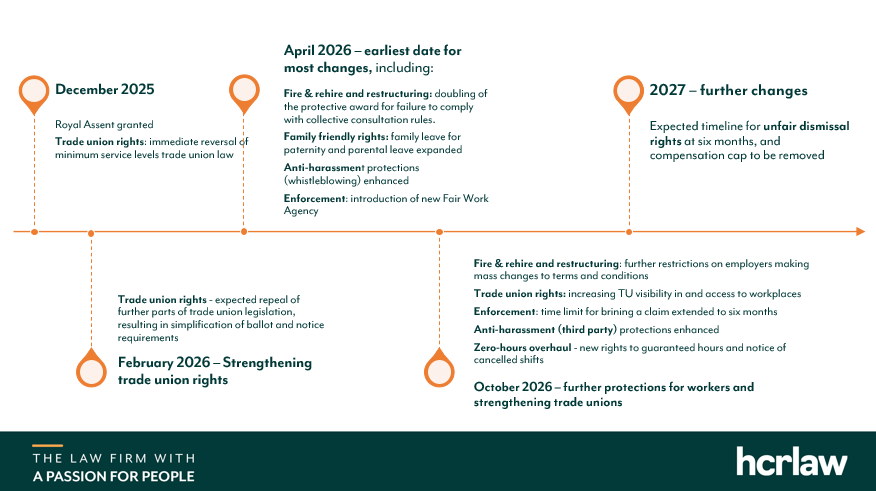
Act roadmap
The Bill has been passed and has now become law. However, there is still a significant amount of detail that will only be set out in subsequent secondary legislation (delegated legislation) which are yet to be drafted, let alone become binding.
The Employment Rights Act 2025 will therefore be the catalyst for change, but the next few years will see more detail released in further supporting legislation. The roadmap below sets out the timeline for when a number of the various measures will take effect.

Actions for HR / People team to take
In readiness for April:
- Update your sickness absence policies and practices (including your HR and finance systems) to ensure that they reflect the new entitlement to receive SSP from the first day of sickness from April
- Update your family leave policies, particularly your paternity leave and parental leave policies, to ensure that they reflect the new “day 1” entitlement to paternity leave (instead of a being dependent on a qualifying length of service) from April, and ensure that managers are aware of the change
- Update your whistleblowing policies, to include “sexual harassment” as an express example of a potentially “qualifying disclosure”, and train all staff to recognise and effectively escalate a complaint or report
- Plan for any forecasted larger-scale restructuring, redundancies, or mass changes to terms and conditions to ensure compliance with collective consultation requirements – the penalties for non-compliance will double in April.
Inside the Employment Rights Act 2025
Employment lawyers Catherine Mitchell, Partner, and Cecily Donoghue, Senior Associate, break down what the Employment Rights Act 2025 means for employers as a wave of further reforms arrive in April 2026.
Drawing on their experience as employment solicitors supporting organisations across sectors, Catherine and Cecily outline the practical steps employers should now be taking to ensure compliance with the changes.
Don’t delay and risk falling behind! Watch this conversation to understand what’s changing and what you need to do. If you need tailored advice on the Employment Rights Act 2025, our Employment team is ready to support you.

Disclaimer
The HCR Employment team continues to monitor the progress of the Act including the government’s published timetables, secondary and delegated legislation, consultations, and other government guidance.
These pages will be updated to reflect any developments, but they do not constitute legal advice. Please get in touch with your normal HCR contact or an Employment Rights Act champion for further advice.
Key contacts
Get in touch with your normal HCR contact or one of your key Employment Rights Act champions below.






Legal insights and thought leadership


Day-one family-friendly rights: immediate rights for parents and carers
Read more
Key changes to statutory sick pay under the Employment Rights Act 2025
Read more
National Minimum Wage and statutory pay increases from April 2026
Read more

‘No permission, no travel’: a new hard line at the UK border
Read more
Global aerospace company on show at HCR Law’s Future Workspaces seminar
Read more


Why transition‑ready exit clauses are essential for business success
Read more
Flipping with purpose: a Pancake Day audit of your renewal mechanics
Read more